
Quality assurance has been changed to become a very automated and intelligent process that is no longer a manual and time-consuming activity. The increase in the pace of digital adoption and the adoption of continuous delivery are putting increased pressure on traditional testing teams to provide faster releases with reduced defects.
To do so, larger groups are resorting to low-code and no-code testing tools, which can automate the process of testing for non-technical developers as well as technical ones. They can lower the scripting efforts, accelerate deployment, and facilitate quick test execution of web, mobile, and enterprise applications.
Gartner states that by 2026, the percentage of new enterprise applications being low-code applications will have almost reached 70. This trend is now applying to test automation since businesses desire scalable automation but without technical complexity. The issue is, will low-code/no-code testing supplant the current testing based on traditional coding, or just develop as a complement to it?
The Shift Toward Democratized Test Automation
Accessibility Beyond Traditional QA Roles
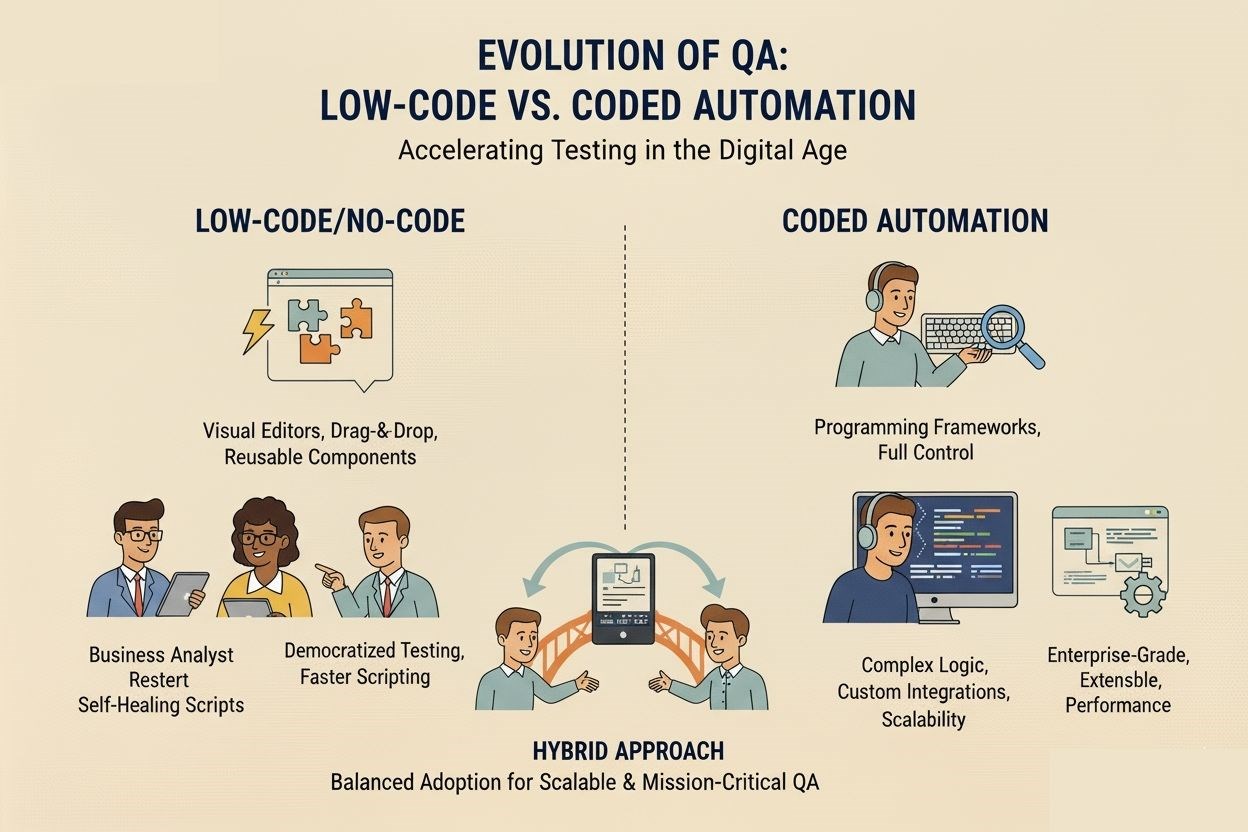
Traditional automation of the test demanded good programming and frameworks. Low-code and no-code test platforms alter this by adding visual editors, drag-and-drop workflows, ready-to-use components, and reusable test assets. This enables the involvement of the manual testers, business analysts, and subject matter experts.
Speed of Implementation
Low-code platforms save time on the script creation and maintenance. Automation suites can be developed by teams in shorter periods than frameworks such as Selenium, Appium, or Playwright, particularly when the regression cycles are large. This is useful in agile and DevOps pipelines where the sprints are short-lived and the frequency of release is elevated.
Cloud- and AI-driven Capabilities
The AI in modern enterprise tools is applied to identify objects, self-repairing scripts, and automatic maintenance of tests. This decreases flakiness and maintains automation even in the presence of changing UI elements.
Comparison: Low-Code vs Traditional Automation
When Low-Code Works Best
Low-code automation is ideal for business-driven applications with continuous UI changes and rapid release cycles. It is relevant for teams lacking deep programming talent or organizations prioritizing speed over large-scale customization.
Use cases include:
- Web and mobile application functional tests
- Regression and user acceptance testing
- Workflow testing in CRM, ERP, and SaaS platforms
- API testing using predefined templates
When Coding-Based Tools Matter
There are scenarios where traditional scripting tools like Selenium remain powerful. They offer more control, scalability, and integration flexibility across enterprise architecture. Organizations with complex test logic, custom validation, and deep system integration often rely on expert-led services similar to professional Selenium automation testing services to build a long-term testing ecosystem.
Performance, Reliability, and Customization
For enterprise-grade performance, browser-level control and extensibility remain critical. Traditional automation enables continuous customization through open-source libraries, making it difficult for low-code tools to fully replace them in complex conditions.
Adopting Low-Code Testing in Enterprise Pipelines
Change Management and Skill Transformation
Introducing low-code testing does not remove the need for skilled QAs. Instead, teams evolve to a hybrid model where technically skilled testers manage complex automation while business-focused users operate low-code capabilities. When the requirements of complex, scalable automation frameworks are needed, the industry-grade Selenium testing services continue to be used by many companies.
Integration With DevOps and CI/CD
Low-code tools will have to be able to integrate with build, release, and monitoring pipelines. CI tools like Jenkins, Azure DevOps, Bamboo, or GitLab should be the ones that prompt automated tests. Enterprise testing maturity is defined by how well low-code tests align with continuous deployment environments rather than just UI-based automation ease.
Real-World Use Case
A financial services company reduced test script creation time by 60 percent using low-code automation. However, 100 percent reliance was not possible because high-security workflows required custom-coded automation for encryption validations, risk scoring logic, and API behavior checks. This shows that hybrid testing is the practical future.
Conclusion
Test automation is being revolutionized using low-code and no-code testing platforms, as they help to accelerate collaboration and make testing more accessible. Nevertheless, they are not going to substitute the old-fashioned coded automation completely.
Balanced adoption is the way ahead of testing, with testers adopting low-code environments to provide quick and fast coverage and coding-based frameworks to ensure scalable and mission-critical automation. Those organizations that thrive will employ an integrated approach to QA supported by talent, equipment, and lifelong learning.
Enterprises looking to elevate automation frameworks and long-term QA maturity consider partnering with specialized engineering teams who understand end-to-end delivery. Businesses seeking expert coding-driven automation capabilities can collaborate with experienced teams that provide access to certified professionals, similar to how some teams choose to hire Selenium developers for custom framework engineering or hire remote Selenium developers when scalability and distributed delivery are required.


Leave Comment